The prompt
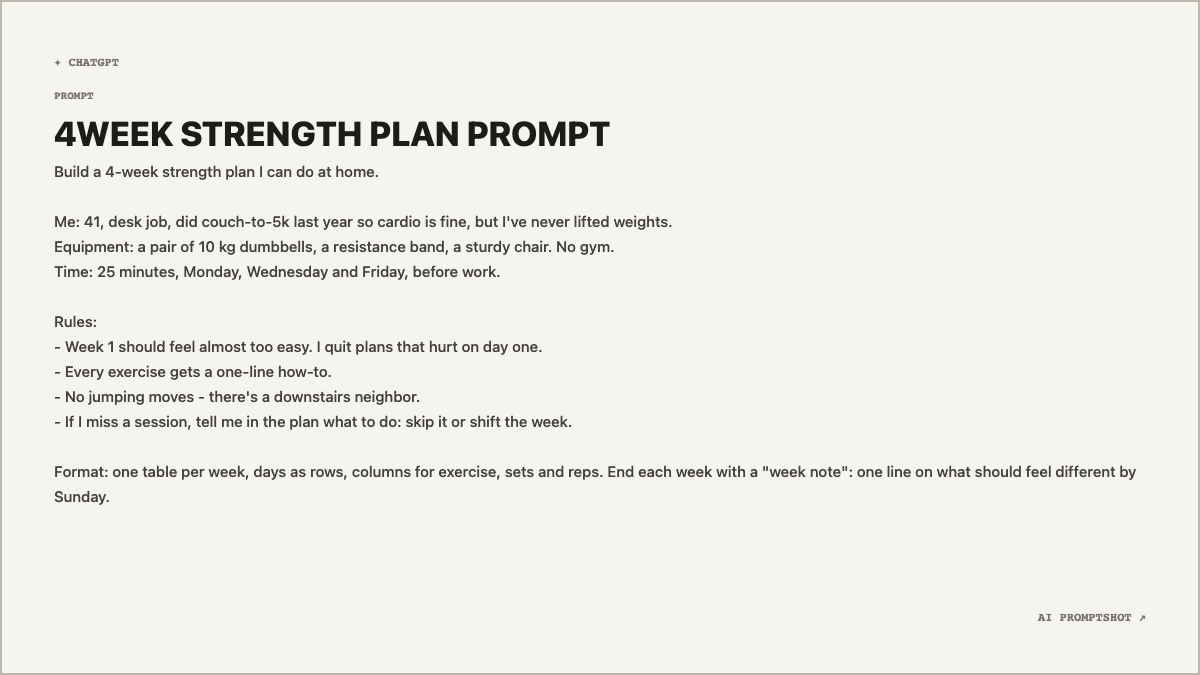
Build a 4-week strength plan I can do at home.

Me: 41, desk job, did couch-to-5k last year so cardio is fine, but I've never lifted weights.
Equipment: a pair of 10 kg dumbbells, a resistance band, a sturdy chair. No gym.
Time: 25 minutes, Monday, Wednesday and Friday, before work.

Rules:
- Week 1 should feel almost too easy. I quit plans that hurt on day one.
- Every exercise gets a one-line how-to.
- No jumping moves - there's a downstairs neighbor.
- If I miss a session, tell me in the plan what to do: skip it or shift the week.

Format: one table per week, days as rows, columns for exercise, sets and reps. End each week with a "week note": one line on what should feel different by Sunday.
The age, equipment and schedule in this prompt are one person's. Replace them with your own before you send it.
Why the Clean template fits
Clean is the everyday template: warm gray-white (#f5f4ef) with a taupe border (#bbb7ac) and near-black text, on the 1200 × 675 Landscape canvas, with the ChatGPT mark. A workout plan is a practical, personal prompt - not technical, not literary - and Clean's plain polish suits exactly that. The Landscape shape gives the rules block and the format line room to sit apart, and the export keeps the line breaks so the plan's structure is visible at a glance.
This is also the card you'd actually post. A "here's the prompt that finally got me training" share in a group chat or in a fitness community reads naturally in Clean's neutral frame, where a dark developer template would look like a mistake.
What makes this prompt work
- The "me" block is honest about the starting point. "I've never lifted" changes everything a good plan does. Vague fitness prompts fail because they're written for the person you wish you were; this one plans for the person who has to show up on Monday.
- Equipment is a closed list. "A pair of 10 kg dumbbells, a band, a chair" doesn't just enable exercises - it rules them out. A barbell move has no place in the answer, because there is no barbell.
- Exclusions get their own lines. "No jumping moves" looks small; it's the difference between a plan you follow and one you quietly abandon after one complaint from downstairs. Every real-life plan has one or two of these deal-breakers, and they belong in the prompt.
- The missed-session rule plans for reality. Plans don't fail in week one; they fail the first time life intervenes and the plan has no answer. "Skip it or shift the week" removes the decision that's hardest to make at 6am.
- The week note builds the feedback loop. One line on what should feel different turns four tables into a progression you can notice, which is what keeps week two from being week one repeated.
Variations
For gym access
Swap the equipment line and the plan opens up - keep every other rule exactly as is; they're gym-agnostic.
Equipment: full gym - racks, barbells, cable machine. I've never followed a program there, so include how to set up each station in the how-to lines.
For a 15-minute lunch-break version
Shorter sessions need density rules, not just fewer exercises.
Time: 15 minutes at lunch, in work clothes - no floor moves, no exercises that need a shower after. Five days a week instead of three.
For returning after an injury
Add the medical line first, and give the plan a stop rule. This is the one variation where caution text belongs in the prompt itself.
Cleared by my physio to train after a shoulder injury. Nothing overhead, nothing that causes pain above 3 out of 10 - if an exercise risks that, substitute it and mark the substitution.
Adapting it to your own work
This prompt's real structure is: honest starting point, closed resource list, hard exclusions, a rule for when things go wrong. That shape works far beyond fitness - meal plans, study schedules, practice routines, budgets. Anywhere a generic template exists, the way off it is the same.
When you reuse it, resist the urge to tidy the "me" block. The specifics you'd polish away - the desk job, the neighbor, the quitting history - are exactly the lines the plan is built on. Keep it honest, keep it plain, and change only what's actually different about you.