The prompt
House voice rewrite. Rewrite the draft below in our voice, keeping its meaning and facts exactly.

Our voice:
- Plain words. Say "use", not "utilise"; "help", not "facilitate".
- Short sentences, but not all the same length.
- Talk to one reader as "you". Never "users".
- Confident without hype: no "revolutionary", no "best-in-class", no exclamation marks.

Do not change:
- Product names, prices, dates, numbers or quoted text.
- Anything inside [square brackets].

After the rewrite, list every sentence where the meaning changed even slightly, so I can check it.

Draft:
[paste draft]
Text in square brackets is a placeholder: replace it with your own notes, diff or draft before you send the prompt.
Why the Editorial template fits
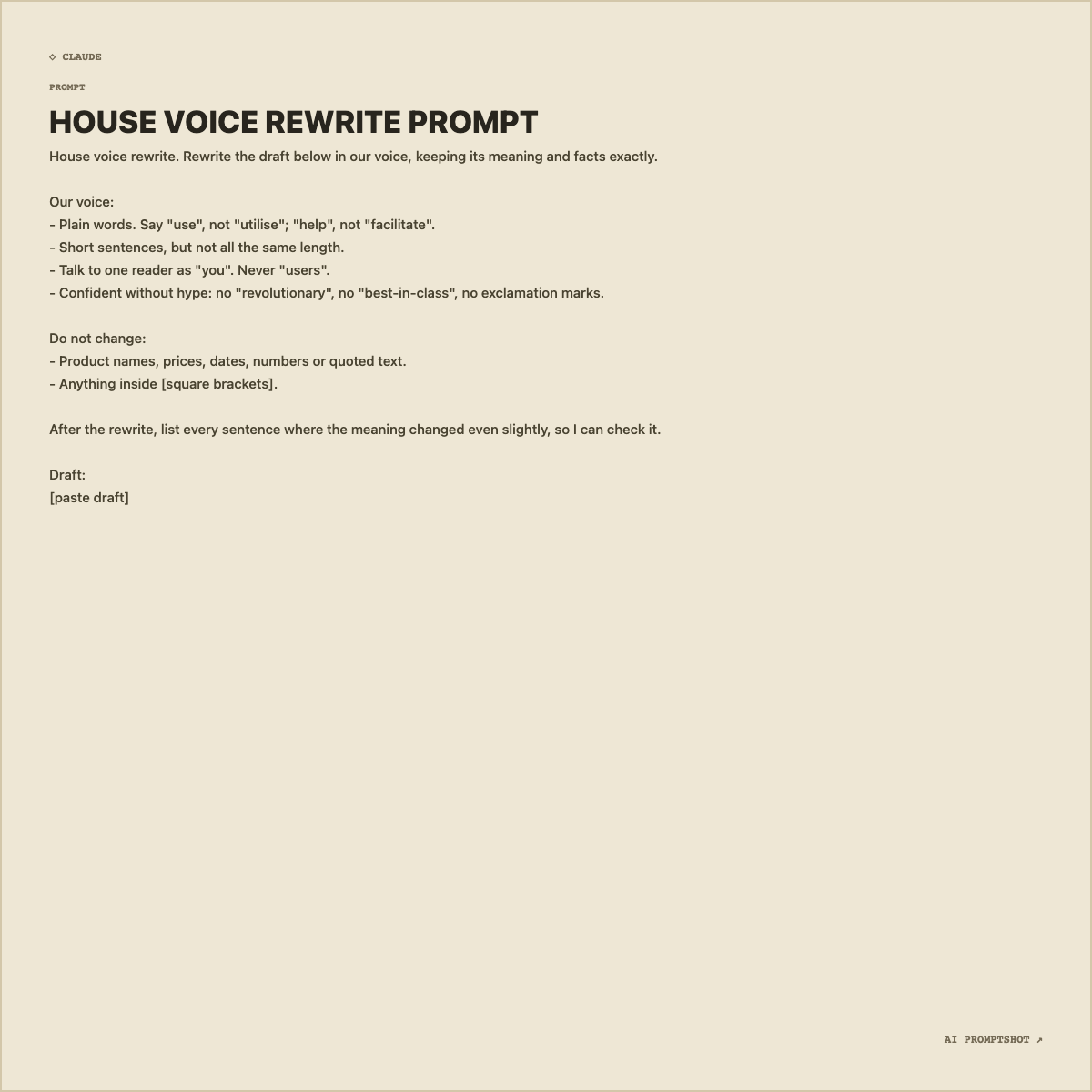
Editorial puts warm beige paper and brown-black text on the 1200 × 1200 Social Square, the larger of the two squares. A prompt with three lists gets enough room to stay readable at a normal type size, where a smaller canvas would have to shrink it. The page-like colour suits writing guidance; it looks like a style sheet pinned above a desk.
Voice prompts tend to live in a brand guide, an onboarding pack for new writers and freelancers, or a shared folder of approved prompts. A square image sits on a slide or a document page without awkward cropping, and the default Claude label can be switched to whatever your team writes with.
What makes this prompt work
- Each voice rule has an example. "Plain words" on its own means different things to different people. "Say use, not utilise" shows the rule in a form that a model and a new writer will both apply the same way.
- Banned phrases are listed, not described. "No hype" is open to interpretation. Naming the exact phrases removes the guesswork, and you can add to the list every time a draft comes back with a new one.
- Facts are protected by category. Names, prices, dates, numbers and quotes are where a rewrite does real damage. Listing categories covers the cases you didn’t think of in this particular draft.
- Square brackets mark fixed wording. This is an escape hatch for legal lines or approved copy. Wrap them in brackets in the draft and they stay put without a separate explanation each time.
- The model reports its own changes. The closing list is the cheapest check you can add. It won’t catch everything, but it shows you where to look first, which matters on a long piece.
Variations
Shortening, not just rewriting
Give a target length and say what may go first. The protected list still applies, so a shorter version can’t drop a price or a date to save words.
Cut it to 150 words. Remove examples and repetition first; never remove anything on the do-not-change list.
Checking instead of rewriting
Sometimes you want the writer to make the edits. Ask for the sentences that break a rule, with the rule named, and no rewrite.
Do not rewrite. Quote each sentence that breaks one of the voice rules and say which rule.
A second voice for another channel
Keep the do-not-change list and the check, and write a shorter set of voice rules for support replies or social posts. Two short prompts behave better than one long prompt full of exceptions.
Voice for support replies: warm, short, first name only, one apology at most, and end with the next step.
Adapting it to your own work
Build your voice rules from real drafts: collect five sentences you rewrote by hand and turn each correction into a rule. Rules made that way are far easier for a model to follow than adjectives like "friendly" or "professional". Read the change list every time, and most carefully on anything legal, medical or financial, where a softened sentence can mean something else.