The prompt
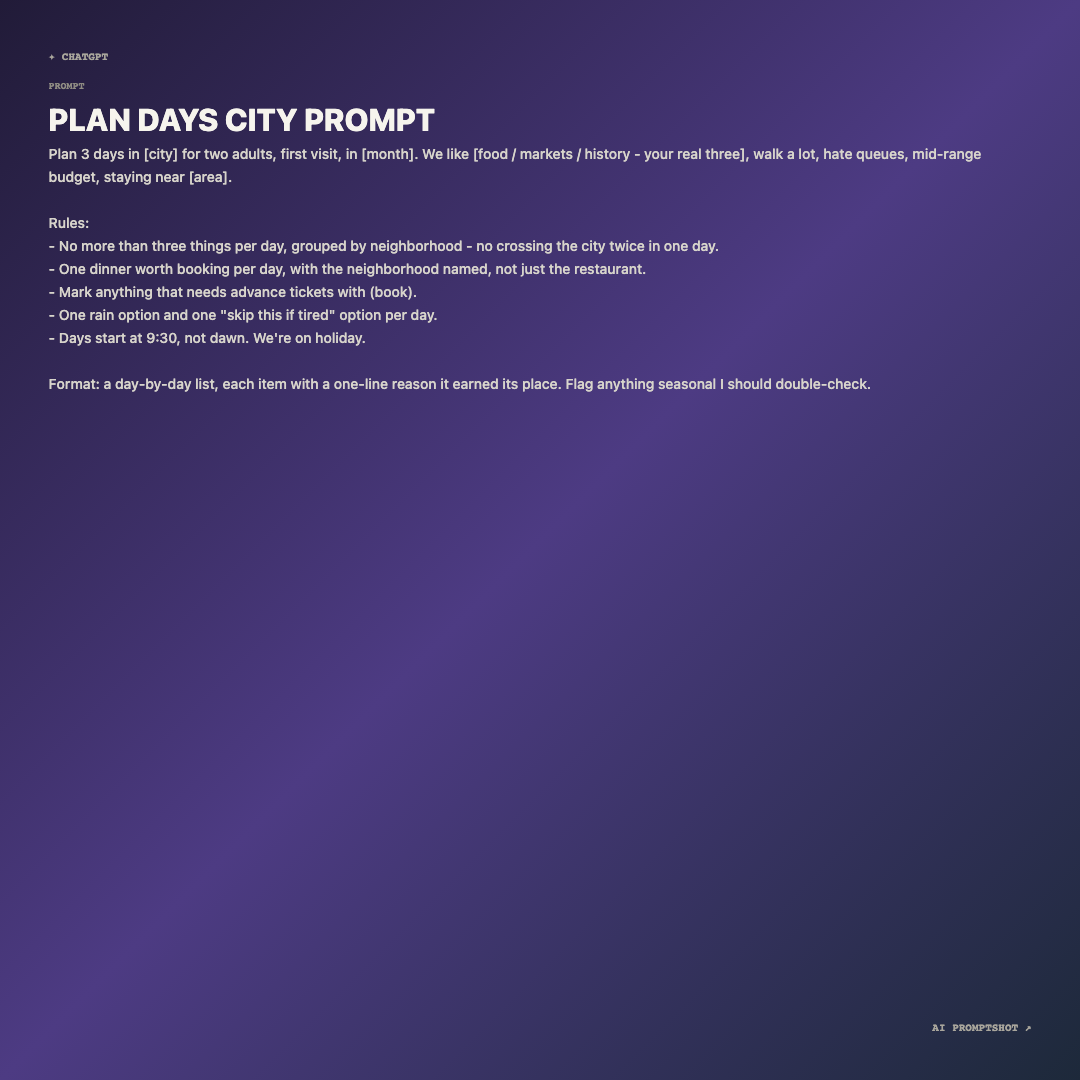
Plan 3 days in [city] for two adults, first visit, in [month]. We like [food / markets / history - your real three], walk a lot, hate queues, mid-range budget, staying near [area].

Rules:
- No more than three things per day, grouped by neighborhood - no crossing the city twice in one day.
- One dinner worth booking per day, with the neighborhood named, not just the restaurant.
- Mark anything that needs advance tickets with (book).
- One rain option and one "skip this if tired" option per day.
- Days start at 9:30, not dawn. We're on holiday.

Format: a day-by-day list, each item with a one-line reason it earned its place. Flag anything seasonal I should double-check.
Text in square brackets is a placeholder: fill in the city, month, your three real interests and where you are staying.
Why the Social template fits
Social is the gradient template: a deep purple-blue blend (#211b38 through #4d3b83 to #1d293a) with light text on the 1080 × 1080 Square, carrying the ChatGPT mark. Trip prompts are made to be passed around: they get posted, forwarded to travel companions, dropped into group chats - and Social's gradient is the one design on the site made to stand out in a feed rather than sit quietly in a document.
The square canvas also suits the prompt's shape: a context block, a rules list, and a format line, kept as separate rows by the export. On the gradient those blocks read like a checklist someone is about to benefit from, which is exactly what gets a card saved and reshared.
What makes this prompt work
- Pace is a number, not a vibe. "Three things per day" is enforceable; "relaxed pace" is not. Real itineraries are made by subtraction, and the number does the subtracting.
- Neighborhood grouping kills the zigzag. The classic generated itinerary has you crossing the city at 2pm for no reason. Stating the rule once heads off a whole category of bad plan.
- Bookings are flagged, not buried. "(book)" next to what needs advance tickets is the difference between a plan and a disappointment at a sold-out door. One small marker saves a wasted journey.
- Rain and tiredness are planned, not improvised. Every trip has both. Having the swap options pre-chosen means a wet Tuesday costs you nothing - you take the rain line and keep walking.
- "A reason it earned its place" forces curation. Without it, lists pad themselves with whatever's famous. Making each item justify itself keeps the day short and the quality up.
Variations
For a business trip
Work trips are half-days around fixed commitments - say where the anchors are.
I'm at a conference until 3pm each day. Plan the evenings and one free morning only, near [venue]. Everything must be doable without pre-booking except the one dinner.
For traveling with kids
Kids change the physics: naps, snacks, and a hard ceiling on museum patience. State the windows.
Two adults, one 5-year-old. Nothing longer than 90 minutes indoors, a playground or open space every day, nap window 1-3pm kept clear, and dinner options that seat families before 7pm.
For a repeat visit
Second trips are for depth; tell it to skip the greatest hits it will otherwise serve you again.
Third visit - skip the famous sights. Neighborhoods over landmarks: markets, local cafés, one thing only residents do. Assume I've seen everything on a top-ten list.
Adapting it to your own work
The transferable skeleton is: state your real tastes, cap the day, group by geography, flag what needs booking, and pre-plan the two bad days. Any itinerary, any city, any group - those five lines do most of the work, and the variations above are just the same rules wearing different weather.
Then the discipline: verify before you commit. Names, opening hours, seasonal closures and prices are exactly the kind of facts that go stale between an assistant's training and your Tuesday. Treat the itinerary as a smart first draft from a well-read friend - check the handful of items you're actually booking, and enjoy the rest.