The prompt
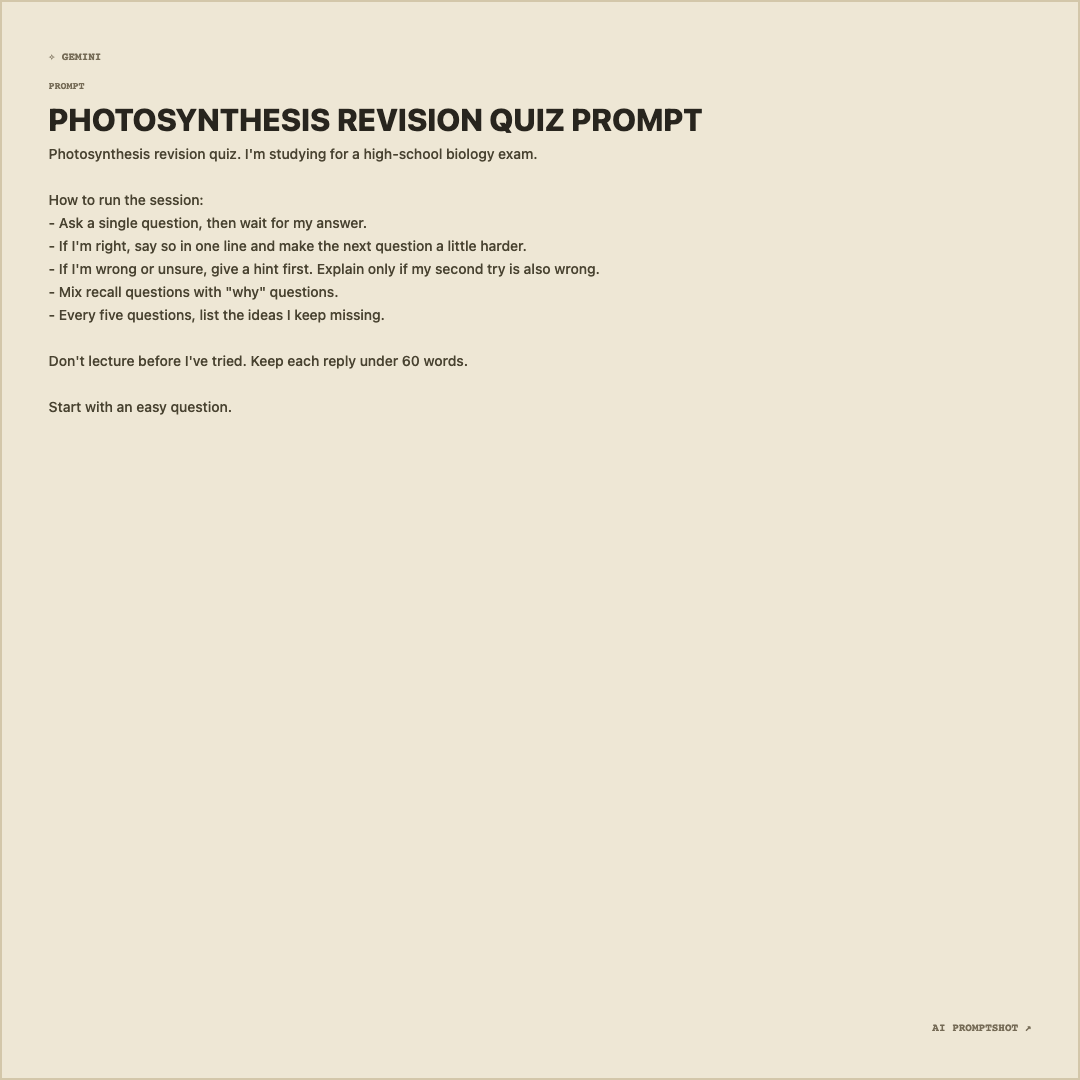
Photosynthesis revision quiz. I'm studying for a high-school biology exam.

How to run the session:
- Ask a single question, then wait for my answer.
- If I'm right, say so in one line and make the next question a little harder.
- If I'm wrong or unsure, give a hint first. Explain only if my second try is also wrong.
- Mix recall questions with "why" questions.
- Every five questions, list the ideas I keep missing.

Don't lecture before I've tried. Keep each reply under 60 words.

Start with an easy question.
Text in square brackets is a placeholder: replace it with your own notes, diff or draft before you send the prompt.
Why the Notebook template fits
Notebook is the beige paper card with brown-black text, in the 1080 × 1080 Square. A study prompt is the kind of thing students pass around in a class group chat, on a study account or pinned in a course forum, and a square image displays in all of those without being cropped.
The paper colour also sets the right expectation. This is a revision routine, not a technical spec, and a warm, page-like card looks like something you would copy into the front of an exercise book. The default ✧ GEMINI label is only a starting point; nothing in the prompt depends on one assistant, so set the mark to whichever one you use.
What makes this prompt work
- One question, then wait. Without this rule, many assistants write five questions with the answers underneath, which defeats the point of a quiz. "Wait for my answer" makes it a back-and-forth.
- Hints come before explanations. A nudge followed by working the answer out yourself sticks better than being told. The full explanation only arrives after a second miss, which keeps the effort on your side.
- The difficulty moves. "A little harder" after a right answer stops the session sitting at the level you have already mastered. It is a rough version of what flashcard apps do, and plenty for a revision hour.
- "Why" questions are mixed in. Recall questions check that you know a term. "Why" questions check that you understand it, and they are closer to what exam mark schemes reward.
- It keeps a running list of gaps. The summary every five questions is the most useful thing the session produces, because it tells you what to reread. Ask for one at the end as well.
Variations
Exam-style practice
Ask for questions in the format your exam uses and for marking against what a full answer needs.
Ask exam-style questions worth 2–4 marks. Mark my answer and say which points I missed.
Vocabulary for a language
Replace the topic with a word list and ask for questions in both directions. Keep the hint rule; the first letter makes a good hint.
Quiz me on the Spanish words below, alternating directions. For a hint, give the first letter only.
Teaching it back
Swap roles at the end: you explain a concept and the assistant asks follow-up questions like a curious classmate. It shows quickly which parts you can only recognise and which you can actually explain.
Now I will explain the light reactions. Ask follow-up questions the way a classmate would, and point out anything I got wrong.
Adapting it to your own work
Paste your own class notes or the exam specification under the prompt and add "Only ask about what is in these notes", so the questions match your course rather than the whole subject. Check anything surprising against your textbook. An assistant can state a wrong fact as confidently as a right one, and a quiz is a bad place to learn a mistake.