The prompt
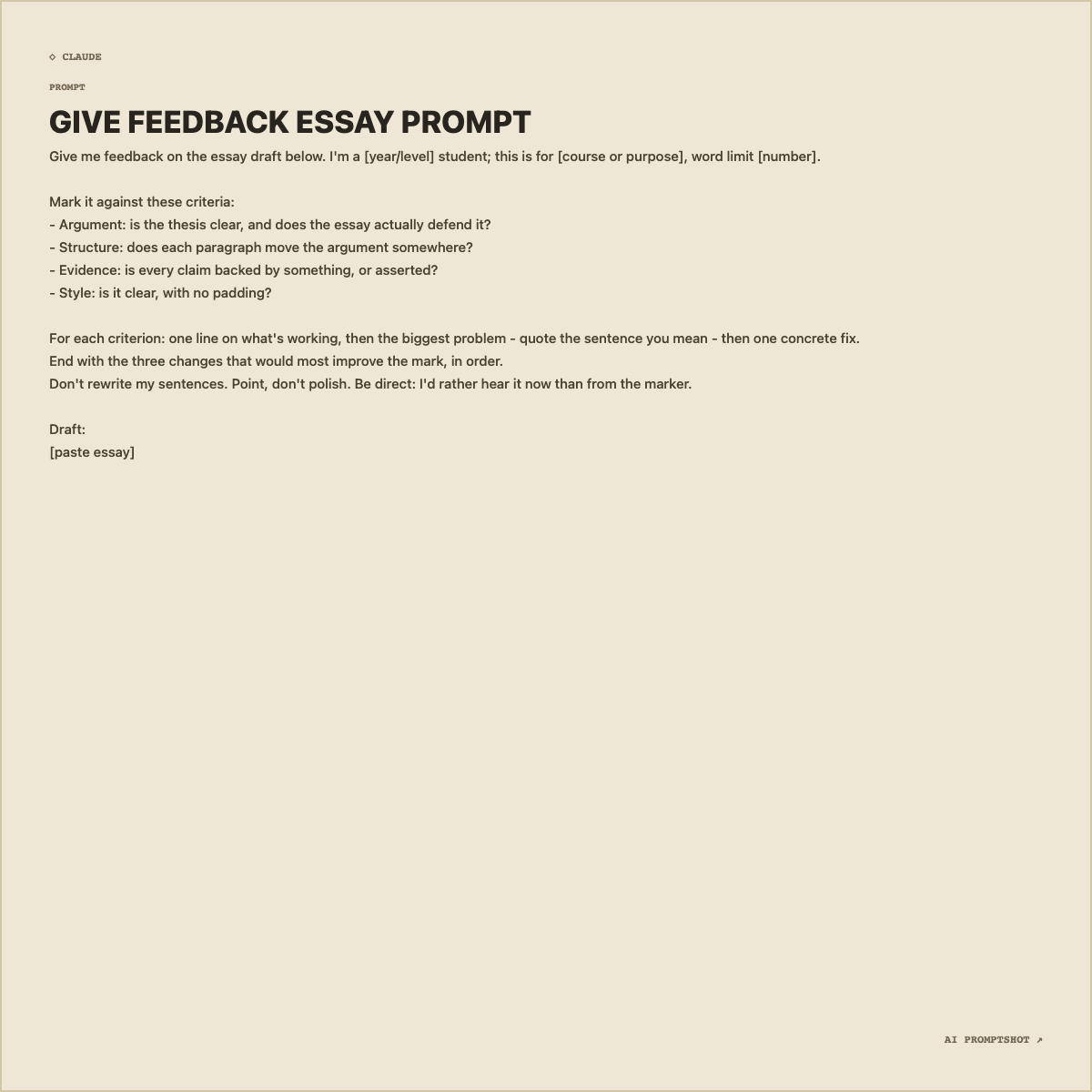
Give me feedback on the essay draft below. I'm a [year/level] student; this is for [course or purpose], word limit [number].

Mark it against these criteria:
- Argument: is the thesis clear, and does the essay actually defend it?
- Structure: does each paragraph move the argument somewhere?
- Evidence: is every claim backed by something, or asserted?
- Style: is it clear, with no padding?

For each criterion: one line on what's working, then the biggest problem - quote the sentence you mean - then one concrete fix.
End with the three changes that would most improve the mark, in order.
Don't rewrite my sentences. Point, don't polish. Be direct: I'd rather hear it now than from the marker.

Draft:
[paste essay]
Text in square brackets is a placeholder: fill in your level, course and word limit, and paste your essay, before you send the prompt.
Why the Editorial template fits
Editorial is the long-form template: brown-black sans-serif text on warm beige paper (#eee7d5), on the big 1200 × 1200 Social Square canvas, with the Claude mark. An essay-feedback prompt is a brief for a careful reader, and Editorial's book-page look matches that register better than a dark developer frame would. The square also holds a multi-block prompt - criteria list, instructions, draft slot - without the blocks crowding each other, because the export keeps your line breaks and blank lines.
It also suits where the card ends up. Study prompts get pinned in class chats, saved into revision folders, and dropped into Notion pages; a paper-toned square sits naturally in all of those, and displays uncropped in a phone feed.
What makes this prompt work
- The criteria are named before anything else. "Give me feedback" leaves the assistant to invent what good means; naming argument, structure, evidence, and style turns the review into four answerable questions instead of one vague one. If your course has a real rubric, paste its headings here instead.
- It has to quote the sentence. This is the load-bearing line. An assistant that must point at your actual words has far less room to retreat into advice that applies to every essay ever written, and when it does misjudge something, the quote shows you immediately what it misread.
- "Point, don't polish." Without this, feedback quietly becomes a rewrite: smoother sentences in a voice that isn't yours, and no lesson learned. Suggestions with reasons travel to the next essay; rewrites don't.
- The three changes, in order. A full review can list fifteen issues, which is how students end up fixing commas while the argument stays broken. Forcing a ranked three separates the marks from the noise.
- "Be direct" sets the read. Drafts need different handling at different stages; telling the assistant you want honesty now, not encouragement, changes what it flags.
Variations
For a near-final draft
When the essay goes in tomorrow, you don't want a structural review - you want the last real problems found. Narrow the scope and the honesty dial stays put.
It's due tomorrow, so skip structural suggestions. Flag only factual errors, unclear sentences, and anything a marker would penalize. Still quote the sentence for each.
For a lab report or science write-up
The shape survives a different genre; only the criteria change. Swap in the ones your discipline actually marks.
Criteria: method (could someone repeat this?), results (numbers with units, no interpretation), discussion (claims tied to the results), figures (each one referred to in the text).
For a personal statement or application essay
Application essays answer a question, and the most common failure is answering a different one beautifully. Add the question itself to the brief.
The prompt question is: [paste it]. Add a first criterion - "does this essay answer the actual question, or an adjacent one?"
Adapting it to your own work
The spine of this prompt is three moves: name the standard, demand quotes, forbid rewrites. Any review task gets better with those - code, cover letters, slide decks, grant applications. Keep the moves, replace the criteria with whatever your field actually marks.
If you have the real rubric, paste it in place of the four criteria; a prompt built on the official marking scheme is worth more than any general-purpose list. And keep the "three changes, in order" line whatever else you edit - prioritization is the part generic feedback never gives you.