The prompt
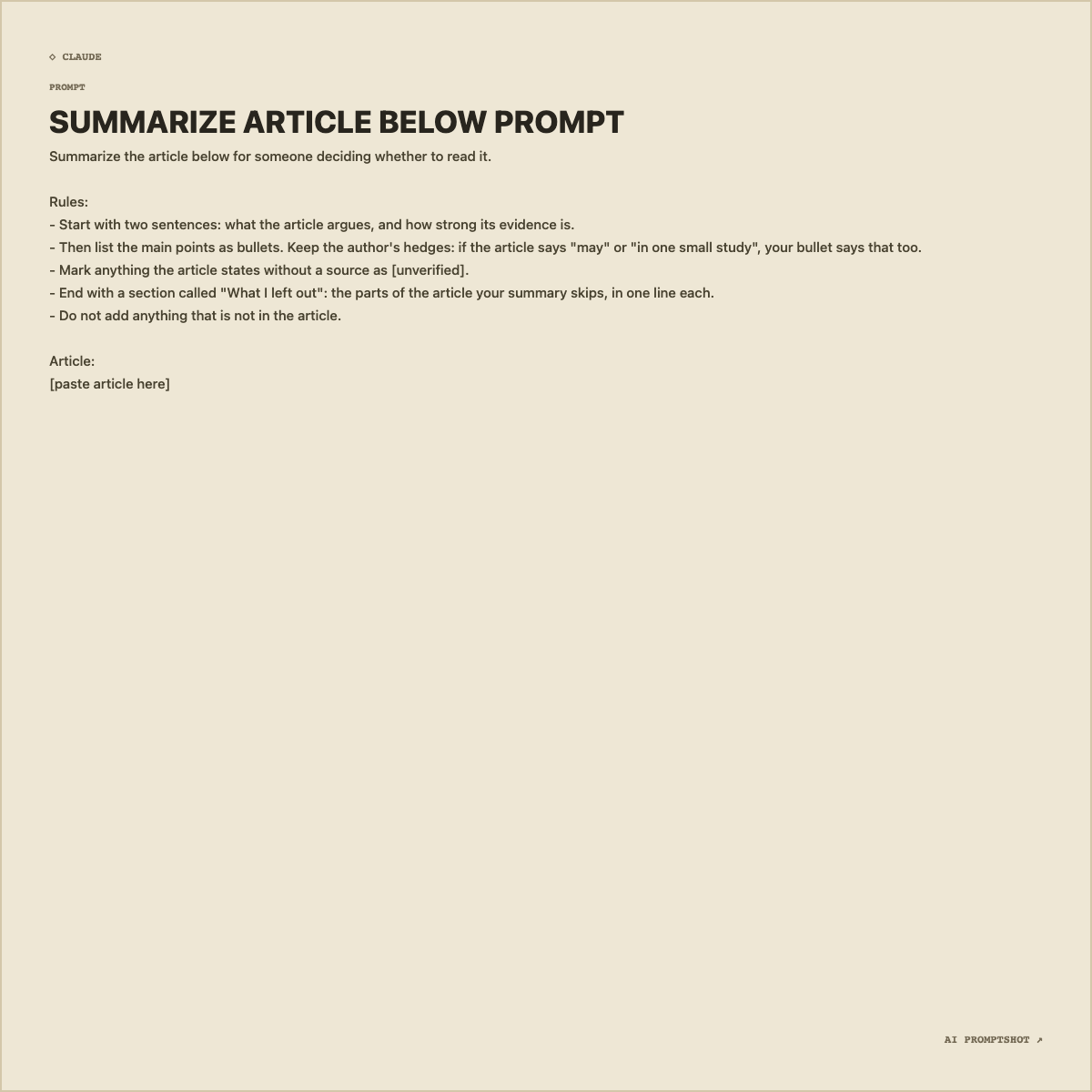
Summarize the article below for someone deciding whether to read it.

Rules:
- Start with two sentences: what the article argues, and how strong its evidence is.
- Then list the main points as bullets. Keep the author's hedges: if the article says "may" or "in one small study", your bullet says that too.
- Mark anything the article states without a source as [unverified].
- End with a section called "What I left out": the parts of the article your summary skips, in one line each.
- Do not add anything that is not in the article.

Article:
[paste article here]
Text in square brackets is a placeholder: replace it with the article before you send the prompt.
Why the Editorial template fits
Editorial sets brown-black text on warm beige paper and gives it the larger square canvas. A summary prompt is read slowly, usually by someone deciding whether the article deserves their time, so the template that behaves like a printed page suits it. The 1200 x 1200 Social Square drops into a newsletter or a doc without cropping, which is where a reading recommendation usually travels.
What makes this prompt work
- It states the reader's decision up front. "For someone deciding whether to read it" changes what a good summary is: not compression, but triage. The model spends its budget on what the article argues and whether to trust it, not on retelling every section.
- Strength of evidence gets its own sentence. Most summaries bury this. Asking for it in sentence two means an opinion piece and a meta-analysis stop looking identical.
- The hedges rule does the heavy lifting. Language models default to confident paraphrase. Naming the failure ("if the article says may, your bullet says that too") works better than a general "be accurate".
- [unverified] makes weak sourcing visible without a fact-check. The model is not being asked to verify claims, only to flag which ones the article itself left unsupported, and that is a job it can actually do.
- "What I left out" turns compression into something checkable. Every summary omits things; most never say which. A named omissions list lets the reader see the bias of the summary at a glance.
- The last rule walls off invention. Summarizers like to add context the article never gave. "Do not add anything that is not in the article" is the line to keep if you cut everything else.
Variations
For a research paper
Ask for the method and sample size in the opening sentences, and limitations as their own bullet. Papers already carry hedges; the risk is the summary upgrading them.
Add after the two opening sentences: the method and sample size in one line, then the authors' stated limitations as bullets.
For a long report or PDF chapter
Cap the length and name the audience, so the bullets are chosen for someone rather than for everyone.
Keep the summary under 150 words, written for a manager who will not read the full report.
For a reading queue
Add a verdict line so the prompt ends with the decision it was built for.
End with one line: READ, SKIM, or SKIP, with the single reason that decided it.
Adapting it to your own work
Change the opening sentence to match the decision your reader is making: whether to cite the article, forward it, or act on it each produce different summaries. If you summarize the same kind of document every week, move the rules into a reusable instruction and keep only the article placeholder here. Whatever else you trim, keep the hedges rule and the omissions section. They are the two instructions that make this more than "summarize this".