Four prompt patterns that make an assistant quiz you, not lecture you
Last updated · By the AI PromptShot team · Editorial policy
Ask an assistant about photosynthesis and you get a tidy page on light reactions. Reading it feels productive. It mostly isn't: recognizing an explanation as it scrolls past is easy, and recalling it a week later is the hard part that exams actually test. Retrieval practice means answering questions from memory instead of reading the answer again, so you do the hard part on purpose. The problem is that an assistant's default is to explain, which puts the easy half of the work on you.
The fix is to write the session rules into the prompt so the assistant stops lecturing and starts asking. Below are four patterns that do this. Each is a reusable shape: swap the topic line and they work for a biology exam, a language vocabulary set, a professional certification, or a new codebase you're trying to learn.
Pattern 1: The quizmaster
The assistant asks one question at a time and waits. Right answer, it gets harder. Wrong answer, a hint before the explanation. This is the pattern behind our study tutor example, and it's the one to start with because it fixes the default in a single move.
The rules that matter:
- One question, then wait. Without this line, the assistant asks five questions at once and you're writing an essay instead of recalling.
- Hint first, explain second. Being stuck is where learning happens; the hint keeps you there a moment longer instead of ending the struggle with the answer.
- Track the misses. A line like "every five questions, list the ideas I keep missing" turns a quiz into a diagnosis of what to re-read.
Pattern 2: Explain-it-back
You do the explaining; the assistant grades it. This is the Feynman technique with a tireless listener: if you can't explain an idea plainly, you haven't learned it, and an assistant can be good at spotting where the explanation goes soft.
The shape:
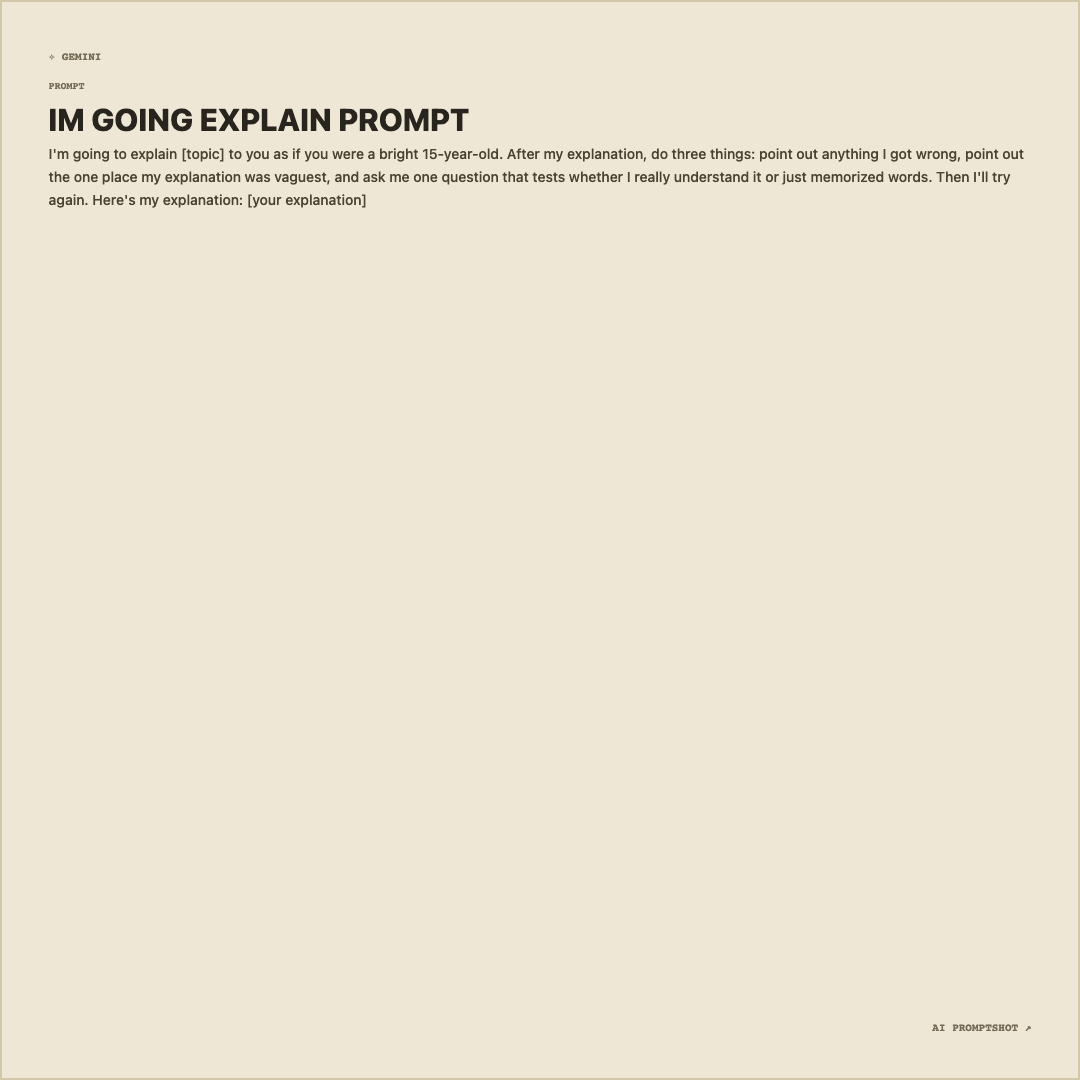
I'm going to explain [topic] to you as if you were a bright 15-year-old. After my explanation, do three things: point out anything I got wrong, point out the one place my explanation was vaguest, and ask me one question that tests whether I really understand it or just memorized words. Then I'll try again. Here's my explanation: [your explanation]
The "vaguest point" line is the engine. Wrong facts are easy to fix; fuzzy understanding hides until someone asks where it lives. Expect two or three rounds before an explanation survives.
Pattern 3: The spaced-review planner
Cramming can carry you through a week, and much of it fades within a month. Spaced review - revisiting material at growing intervals - is the standard fix, but building the schedule is boring enough that few people do it. That part is a fine job for an assistant, as long as you make the sessions retrieval-based rather than re-reading.
The shape:
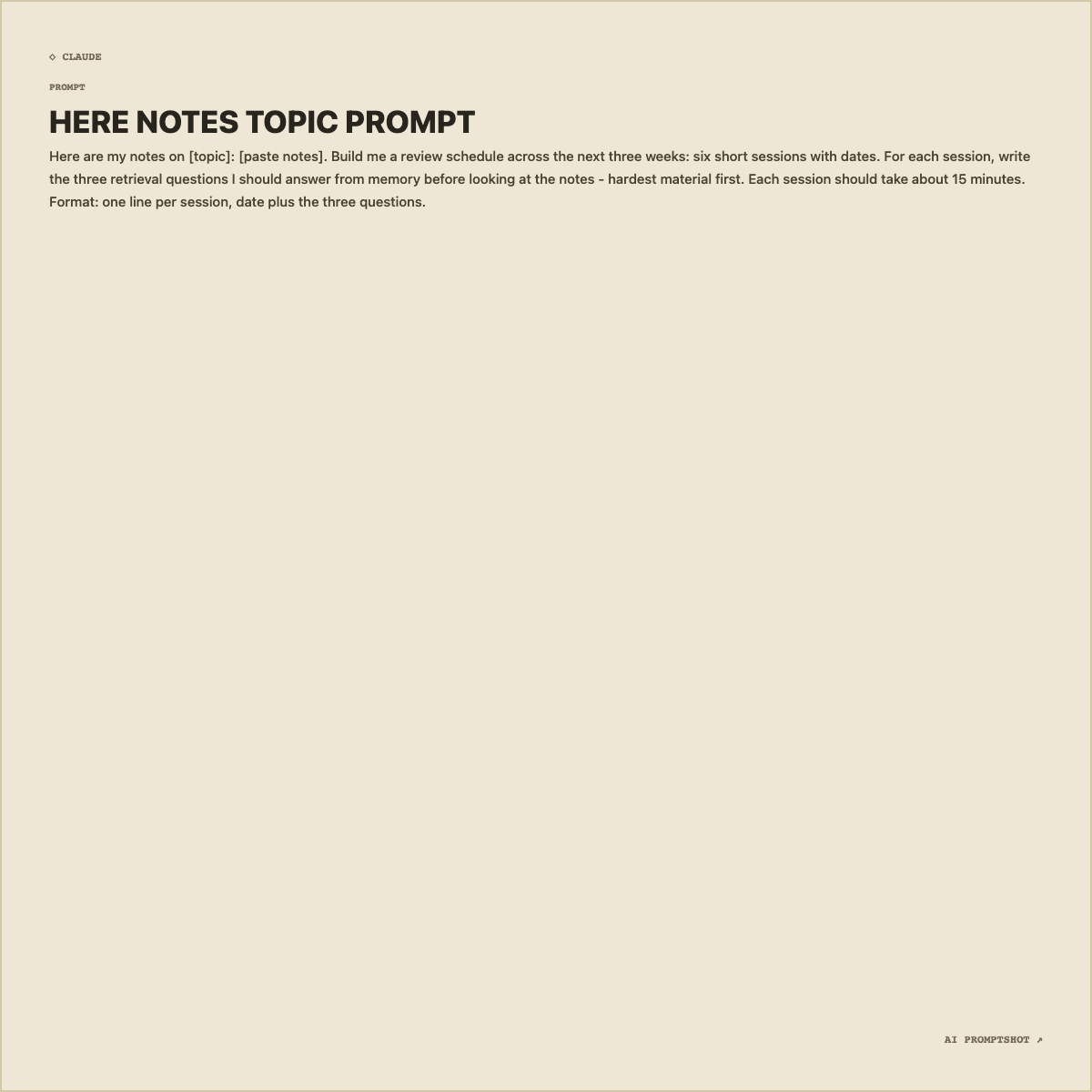
Here are my notes on [topic]: [paste notes]. Build me a review schedule across the next three weeks: six short sessions with dates. For each session, write the three retrieval questions I should answer from memory before looking at the notes - hardest material first. Each session should take about 15 minutes. Format: one line per session, date plus the three questions.
Two things do the work here: the questions are written in advance (so each session starts with recall, not reading), and "hardest first" front-loads the material you're most likely to skip. Save the prompt - after the exam, change the topic line and reuse the whole shape for the next subject.
Pattern 4: The mistake miner
Practice questions tell you that you're wrong; this pattern tells you why. Paste your wrong answers and let the assistant find the pattern across them.
The shape:
Below are questions I got wrong on practice tests for [subject], with my wrong answers. Read across all of them and find the pattern: am I misreading the question, missing a concept, or making slips? List the one or two patterns you find, with the questions as evidence. Then write three new questions that target the main pattern, one at a time, and wait for my answers.
One wrong answer is an accident; five are a curriculum. "With the questions as evidence" matters - it stops the assistant from handing you a generic "you struggle with word problems" and forces it to point at what you actually wrote.
Adapting the patterns
Every pattern here has the same anatomy: a topic line you replace, session rules you keep, and an order of operations that puts recall before explanation. When you adapt one, edit the topic line and leave the rules alone - the rules are where the studying happens.
Two habits make all four patterns more useful. First, run them over several short sessions rather than one long one; twenty minutes of quizzing beats two hours of scrolling explanations. Second, keep the prompts, the way each of the prompt examples keeps one. A study prompt that worked for one exam is a head start on the next, and the image version is easy to pin in a class group chat or save with your notes, which is what a prompt card is for.