The student's prompt checklist: ten checks before you hit send
Last updated · By the AI PromptShot team · Editorial policy
Used well, an assistant is the study partner who never sleeps: it will quiz you at midnight, rephrase an explanation for the fourth time without sighing, and build practice questions from your own notes. Used badly, it's an expensive way to read confident-sounding summaries you won't remember.
The difference is the prompt. Run these ten checks before you send a study prompt and you'll land on the useful side more often.
The checklist
1. Name the exam and the level. "High-school biology, photosynthesis unit, exam in three weeks" sets the pitch. Without it you get an answer aimed at nobody - too shallow for a final, too deep for an intro.
2. Paste the actual material. Your notes, the chapter section, the slide text. An assistant working from your real material stays on your syllabus; one working from its general knowledge drifts into what you won't be examined on. If the material is long, paste one topic at a time.
3. Ask to be quizzed, not told. "Quiz me" beats "explain" for anything you'll need to recall. Explanation is the assistant's default, and reading explanations is one of the study methods that feels best and sticks least.
4. One question at a time. Add "ask one question, then wait for my answer." Otherwise you get ten questions at once and end up writing an essay, which is not recall practice.
5. Hints before answers. "If I'm stuck, give a hint first; explain only if my second try is still wrong." The struggle is where the learning happens - don't let the assistant end it early.
6. Make it track your misses. "Every five questions, list the ideas I keep getting wrong." That list is your revision plan, written by your own errors.
7. Cap the replies. "Keep each reply under 60 words" keeps a quiz snappy and stops the lecture habit from creeping back in.
8. Check its facts against your materials. An assistant can state a wrong fact in the same confident tone as a right one. For anything that will be marked - dates, formulas, definitions - verify against your notes or textbook. Treat its questions as practice, its statements as claims.
9. Never paste what isn't yours to share. This includes other students' work and anything your school would count as misconduct. And know your school's rules on AI help before you use it on assessed work - the line between study aid and ghost-writing is yours to respect, not the tool's.
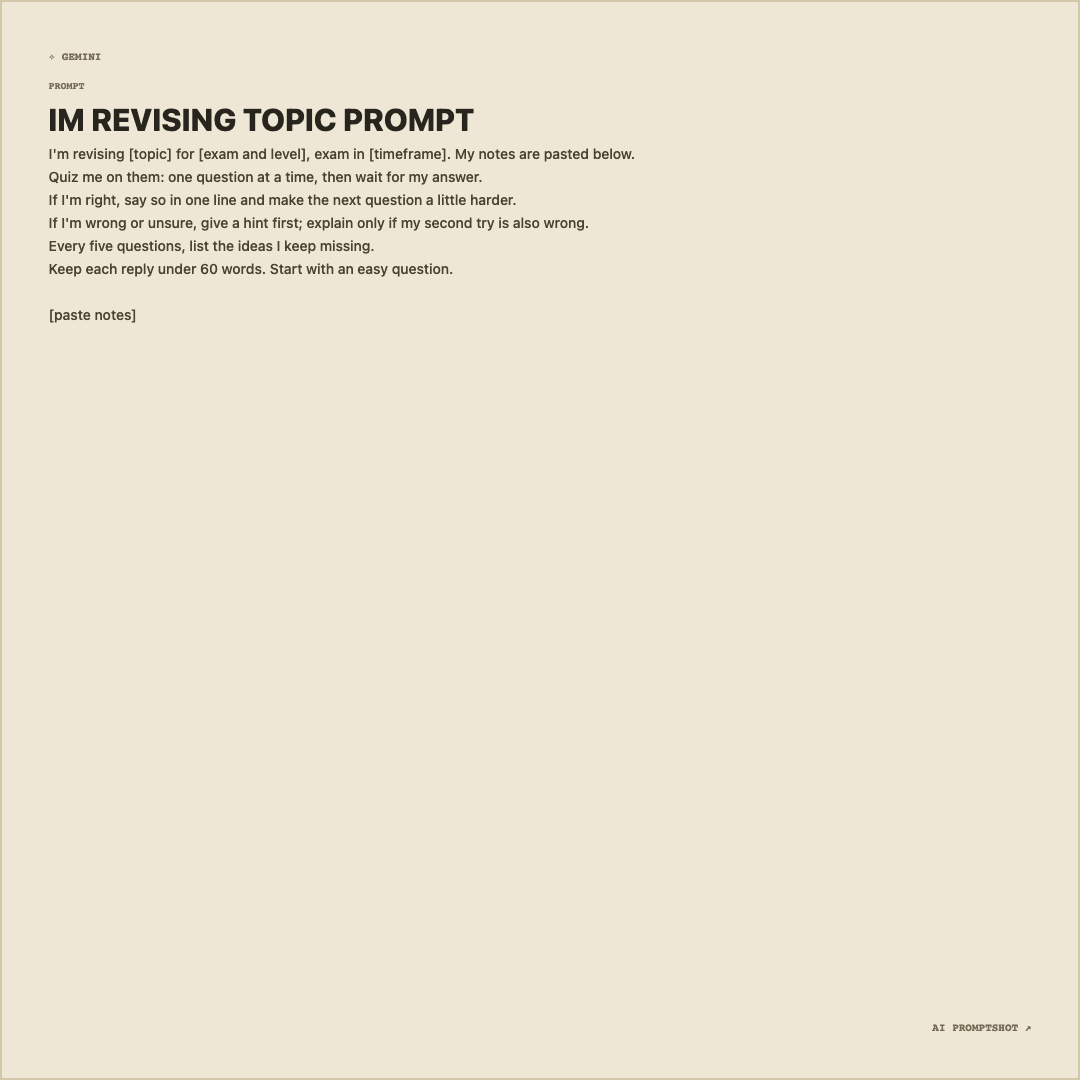
10. Save the prompt that worked. A good study prompt survives the exam. Change the topic line and it's ready for the next subject, so keep it somewhere you'll find it - notes app, or as an image card pinned with your revision materials.
When it checks your work
Quizzing flips the assistant into examiner, and you can push that further: paste your own answer - a worked problem, a paragraph of an essay plan - and ask it to mark the answer against your pasted notes. "Here is my answer and here are the notes it should be based on. Mark it: what's right, what's missing, what's wrong. Be specific, quote me." The quote-me rule matters: vague praise ("good understanding!") teaches nothing, and neither does vague criticism.
One line you should never cross: having it write assessed work for you. Apart from the misconduct risk, it skips the only part that was worth anything. Use it to practice, quiz, and diagnose - the writing stays yours.
Three short sessions beat one marathon
Spacing works for prompts the same way it works for revision. Twenty minutes of quizzing on Monday, Wednesday, and Friday tends to stick better than an hour in one sitting, and short sessions fit the one-question-at-a-time format naturally. When you come back, don't restart from zero - paste the "ideas I keep missing" list from last time and ask it to start there.
Putting it together
Here's the checklist turned into one prompt, ready to adapt:
I'm revising [topic] for [exam and level], exam in [timeframe]. My notes are pasted below. Quiz me on them: one question at a time, then wait for my answer. If I'm right, say so in one line and make the next question a little harder. If I'm wrong or unsure, give a hint first; explain only if my second try is also wrong. Every five questions, list the ideas I keep missing. Keep each reply under 60 words. Start with an easy question. [paste notes]
Change the three bracketed parts and nothing else - the session rules are the working part, and they don't need your edits.
Where to go next
The four study patterns page covers the full set - explain-it-back, spaced review, and mistake mining - with a ready prompt for each. And if you want to see a quizzing prompt broken down line by line, the study tutor example does exactly that.