The writer's prompt checklist: ten checks before you hit send
Last updated · By the AI PromptShot team · Editorial policy
The most common way writers use an assistant is also the least useful: paste a draft, type "make this better," receive a rewrite in a voice that belongs to no one. The draft is smoother and deader. You revert.
The assistant is a far better editor than ghostwriter - but only if your prompt reads like a real editing brief. These ten checks get you there.
The checklist
1. Paste the draft, always. "Give me feedback on my piece" with no piece attached gets you generic writing tips. The draft is the job.
2. Name the reader and where it runs. "For a client newsletter read by busy finance directors" or "a personal blog, conversational." The same paragraph is tight in one venue and wrong in another; the assistant can't judge fit without the venue.
3. Say what kind of feedback you want. Structure, argument, clarity, line edits, or proofreading - pick one, maybe two. Asking for everything at once gets you shallow notes on all of it.
4. One pass at a time. Structure first, sentences later. If the opening section should move, polishing its sentences is wasted work, and a good editor - human or otherwise - will tell you so. Ask for passes in that order.
5. Protect your voice explicitly. "Keep my voice. Flag sentences that sound off to you, but don't rewrite whole paragraphs - suggest, don't replace." Without this line, the default tends to iron the draft flat.
6. Ask for a reason with every change. "For each suggestion, one line on why." A change with a reason is a lesson; a change without one is a coin flip. It also makes bad suggestions easy to spot and ignore.
7. Hand over the house rules. If you follow a style guide - banned words, Oxford comma, sentence-case headings - paste the relevant rules. An assistant can follow conventions you state; it cannot follow ones it hasn't seen.
8. Set the stakes and the limits. "This is a first draft, be direct, I can take it" versus "this is nearly final, only flag real problems." The same draft needs a different read at different stages.
9. Ban your own crutches. You know your habits: "delve," "in today's fast-paced world," three adjectives where one would do. List your known tics and ask for them to be flagged. It is oddly satisfying.
10. Steal the suggestions, not the sentences. The healthiest working pattern: take the diagnosis, write the fix yourself. Your drafts improve, and so does your writing. The assistant that rewrites everything teaches nothing and flattens everything.
Getting unstuck on a blank page
This checklist is for drafts, but the same assistant unblocks the blank page - with one guardrail. Ask for angles, questions, and outlines, not prose: "Give me five angles on [topic] for [reader], each as a working title and one line on why they'd care." Pick one, then write the ugly first draft yourself. The moment the assistant writes the draft, every later pass is editing its voice back into yours, which is harder than writing badly once.
What this checklist is not
It's not a guide to getting an assistant to write your pieces for you. That path produces text that reads like everyone else's, because it is - the average of countless articles, smoothed. Your byline deserves better, and so does your reader. Editing briefs, diagnoses, second opinions: those multiply what you already have.
Feedback on the piece vs feedback on you
A draft review improves one piece. A pattern review improves the writer. Every so often, paste two or three pieces side by side and ask the bigger question: "Read across these. What habits show up in all of them - openings, sentence lengths, hedging words? Name three, with an example of each." You're asking for the tics you can't see from inside, and the answer is usually uncomfortable and useful in equal measure. Bring that list back to check 9 and ban the worst of them explicitly.
The brief
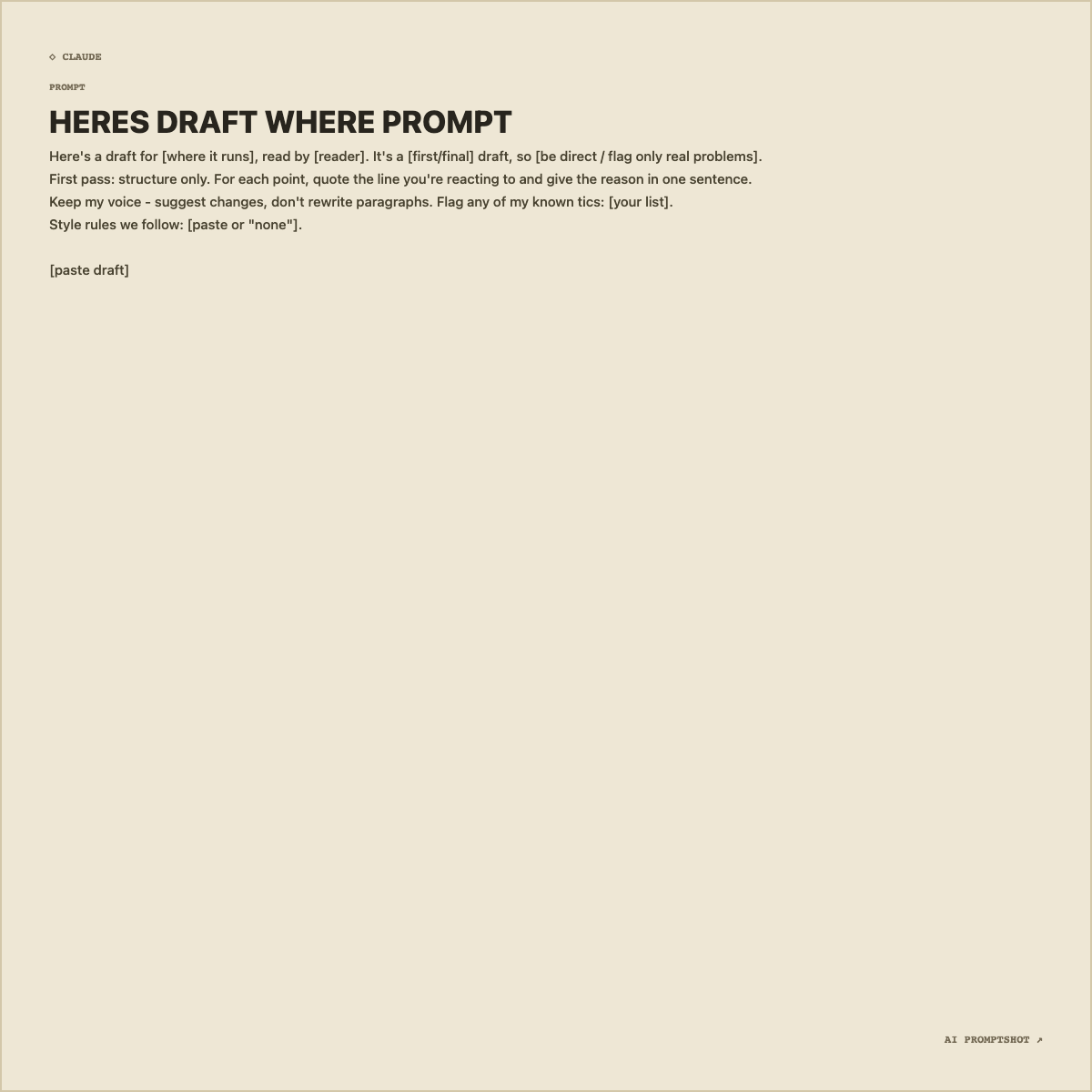
All ten, collapsed into a brief you can reuse:
Here's a draft for [where it runs], read by [reader]. It's a [first/final] draft, so [be direct / flag only real problems]. First pass: structure only. For each point, quote the line you're reacting to and give the reason in one sentence. Keep my voice - suggest changes, don't rewrite paragraphs. Flag any of my known tics: [your list]. Style rules we follow: [paste or "none"]. [paste draft]
Fill the brackets and keep the rest. After the structure pass, send "now line edits on the parts that survived" as a follow-up in the same chat.
Where to go next
The brand voice example shows a complete rewrite brief where the voice rules are written as a mini style guide - the pattern to copy when your publication has one. And if your problem is getting a draft out of a blank page rather than improving one, the before/after rewrites guide has a content-ideas prompt that starts from audience and angle instead of a blank "give me ideas."