Why long prompts drift, and how to fix them
Last updated · By the AI PromptShot team · Editorial policy
There is a moment every heavy prompt user hits: you write a magnificent page-long prompt covering every case, and the answer ignores half of it. So you add more rules. The answer gets worse, not better.
You could call that drift. The way out is almost never more words.
What drift looks like
Drift has a recognizable pattern. Often the assistant nails the first few instructions, drops a rule from the middle, and follows the last thing you said most faithfully of all. Ask for a 200-word summary in a table with citations and a friendly tone, buried in twelve other requirements, and you'll likely get the table - it came last - with the word count and citations quietly gone.
Long conversations drift the same way. Instructions given at the start fade as the chat grows; by message thirty, your opening "always answer in French" may as well not exist.
Why it happens, in plain words
No magic and no malice. A model generates its answer by weighing everything in front of it, and not all of that text weighs the same. Recent text tends to weigh more than distant text. A clear, specific instruction tends to weigh more than a vague one. And two rules that pull in different directions force a silent choice you never see being made - "be thorough" and "keep it under 100 words" cannot both win, so the model picks one and tells nobody.
A page-long prompt is twenty instructions competing for that attention. Each one you add dilutes the rest. That is the mechanism in plain words, and it's why the fixes below are all forms of subtraction or sharpening.
The fixes
Cut to the rules that matter. Most long prompts accrete: every past failure added a patch line, and the patches now outweigh the job. Delete any rule that guards against a failure you haven't actually seen. Ten load-bearing instructions beat thirty anxious ones.
Put the task first and the critical rule last. The task line anchors the answer, and the final line is the best real estate in the prompt. If exactly one rule must survive, repeat it at the end: "Remember: under 200 words, whatever else you include."
Turn prose rules into a checklist. A paragraph of requirements reads as one blurry block. The same requirements as a bulleted list - one rule per line, each starting with a verb - are easier to follow and far easier for you to audit when something's missing.
Swap rules for examples. Three sentences describing your house style are weaker than one example written in it. Where a rule keeps failing, show the thing instead. (Our few-shot guide covers this in detail.)
Split the job into two prompts. If the prompt contains the word "then" between two big tasks, it's two prompts wearing one coat. Ask for the outline, check it, then ask for the draft. Two small prompts you steer beat one big prompt you watch fail.
Fence the material off from the instructions. When you paste a document inside a long prompt, mark it clearly - a line of dashes, or "TEXT STARTS / TEXT ENDS". Without a fence, a sentence inside your pasted text can read as just another instruction and the rules around it blur.
A worked trim
Here's the kind of prompt that drifts, written in a shape people often send:
I need you to help with our release notes, they're very important to the company, please make them engaging but professional, also concise, don't use jargon, but do explain technical things, mention all the fixes, group them somehow, the tone last quarter was too dry, marketing complained, also don't make it sound like marketing wrote it, keep it short but complete, and use British spelling.
More than a dozen instructions, several contradicting. Trimmed to what actually decides the output:
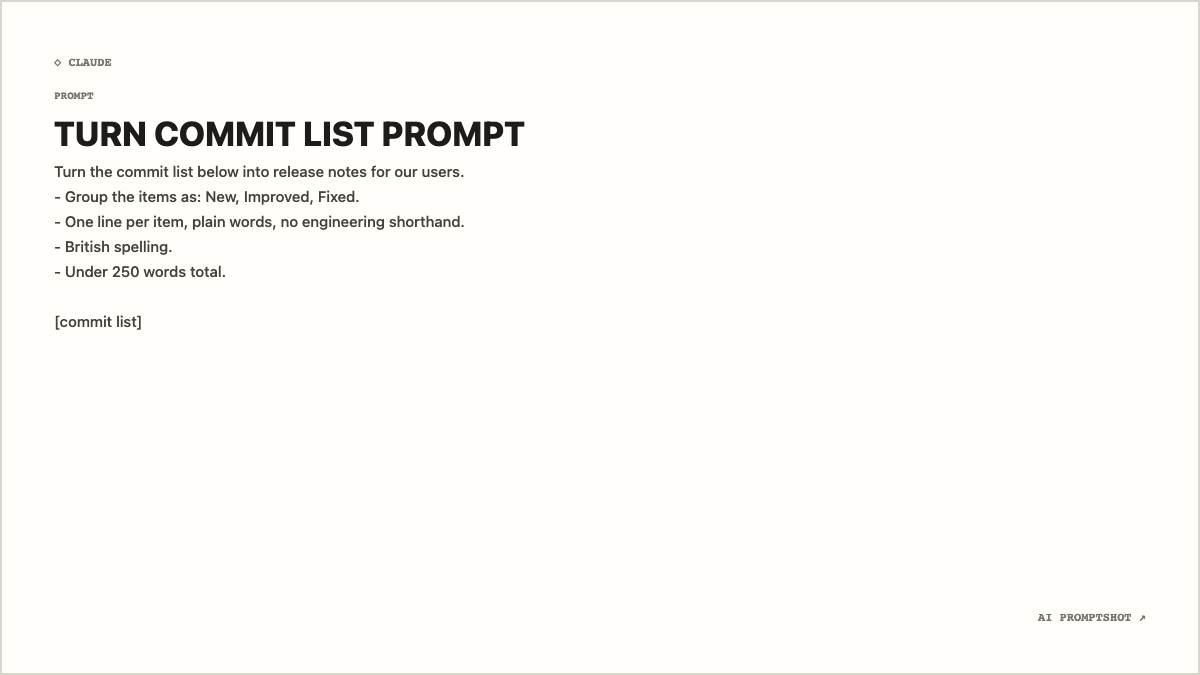
Turn the commit list below into release notes for our users. - Group the items as: New, Improved, Fixed. - One line per item, plain words, no engineering shorthand. - British spelling. - Under 250 words total. [commit list]
Everything cut was either contradictory (engaging-but-not-marketing), uncheckable (very important), or already implied by the kept rules. The trimmed version is about two-thirds the length and much more likely to arrive intact.
The habit that prevents drift
Write the short version first. Add a rule only when an answer actually breaks without it, and when you add one, say it in a single line. A prompt maintained that way can stay sharp for months; a prompt patched in panic grows into the page-long shape that drifts.